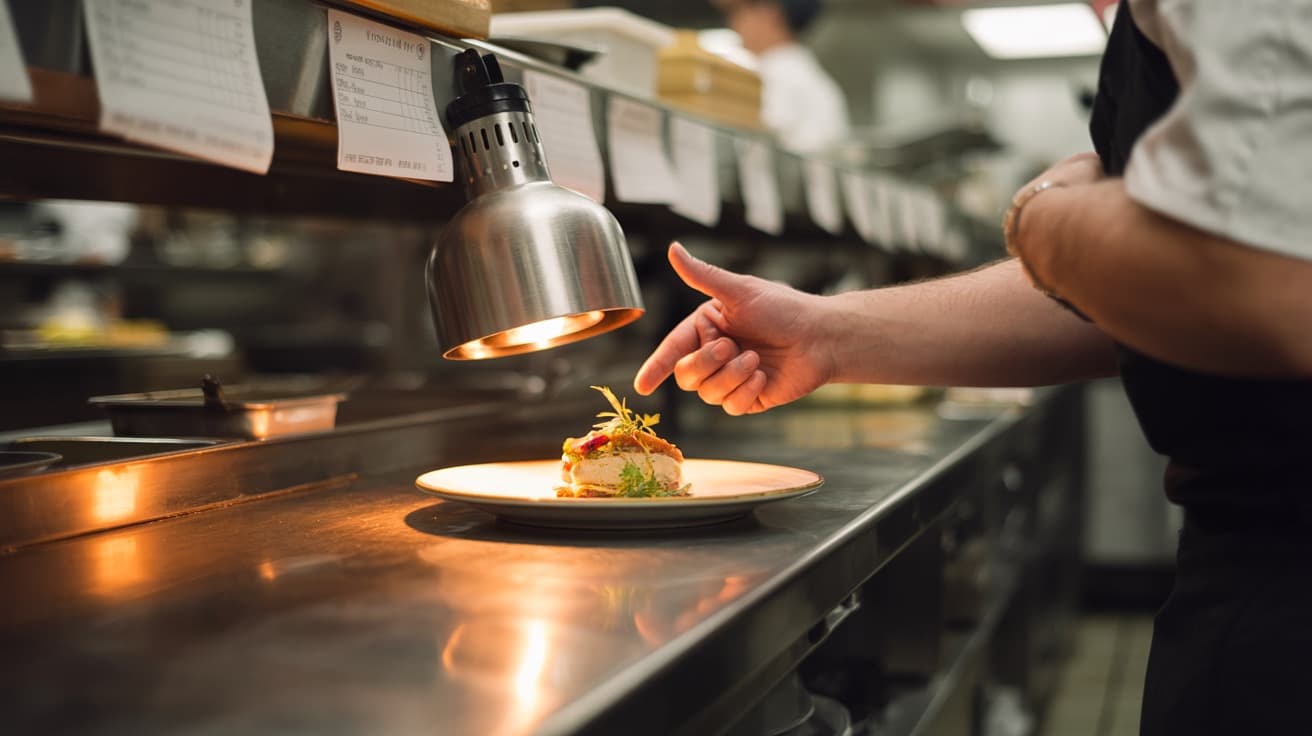
Every operator I know answers inconsistency with more training. I did it for years. Retrain the line, rewrite the spec, run another certification, and by week three the plates drift right back to where they were. The research on this is not ambiguous, and it says training is close to the weakest lever in the building. Consistency at scale gets made somewhere else entirely: at the pass, by one person who looks at every single plate before it leaves.
The most consistent kitchen in America
It’s Cheesecake Factory, and almost nobody in our industry believes me when I say it. A kitchen manager grades every plate 1 to 10 as it comes off the line. A six is unacceptable and gets remade, no discussion. That discipline holds a 2.5 percent food waste target on a 250-item from-scratch menu across more than 80 million covers a year, roughly half of what the industry calls a good number. One manager at the pass, looking at every plate that came off the line, is what produced that number.
Starbucks closed 7,100 stores and cannot show it worked
They shut the whole system down for an afternoon to retrain baristas on espresso, and to this day there’s no clean evidence it moved the drink. Look wider and the pattern is worse: chains land at 86 to 87 percent drive-thru accuracy essentially regardless of what they spend teaching people. Thirteen out of a hundred guests get the wrong order, every year, forever. If training were the lever, that number would move when the budget moves. It doesn’t.
The cook does not read the spec
Atul Gawande tells a story I have lived a hundred times. He asks a broiler cook, eight years on that station, whether he uses the recipe on the screen above him. The cook says no, and taps his temple. “I have the recipes right here.” He’s right, and the spec was never written for him in the first place.
The spec is for the person at the pass. Its only job is to give the expediter a vocabulary precise enough to correct with. “Is that three quarters of an ounce of Parm-Romano?” gets a plate fixed in four seconds. “This looks sloppy” starts an argument and changes nothing. Same observation, two different outcomes, and the difference is whether the inspector had a number in her mouth.
So I built The Standard to fade
That finding rebuilt the concept operations tooling I’ve been working on inside Staj. The build card scaffolds, then it fades by tier. Measured live on a cocktail build: a trainee sees 12 steps and 10 numbers, and a champion on the same drink sees 3 steps and 2 numbers, because the recipe is already in his head and the other nine lines were just noise slowing his hands down.
What never fades is the gates. The real critical control points stay on screen at every tier, for everyone, including the guy who’s made it four thousand times. The fade is reversible in one tap, so a champion coming back from vacation can pull the full card without asking permission. And it prints in full at every tier, because the binder does not fade. The binder is the record.
Grade the plate, never the person
There is no 1-to-10 score attached to a name anywhere in the system. The plate goes, or it’s remade. That’s the whole vocabulary. Score people and you get a politics problem sitting on top of a food problem, and the scores start drifting up around week five.
One more piece, and it took me three versions to accept it. If the expediter presses “it goes” while a deviation is live, the system logs a remake anyway. A gate you can talk your way past is a suggestion with a nice interface.
Put the model where the inspection happens
Here’s the applied part. Almost all of the AI money moving through F&B right now is going into training content, because training content is the easiest thing to buy and the easiest thing to put in a deck. It’s also the lever the evidence says barely moves. Put the model at the pass instead.
Give the person expediting two things a human expediter runs out of on a Saturday: vocabulary and memory. Vocabulary means the model can name the miss in numbers, not adjectives, on the plate in front of her. Memory means it knows this is the fourth short pour on that well tonight and the third since the ice bin was refilled. Then let The Standard fade for the cook who has already earned it, and let the gates hold for everyone. That’s a small, boring, measurable piece of software, and it does more than any module I’ve ever paid for.
Anticipation needs a floor that holds
Everything I care about building lives on top of this. Guests come back for the surprise, the unveiling, the thing they didn’t see coming, and that’s the part I actually love inventing. But you only get to sell wonder if the ordinary plate lands identically at 6:15 and at 9:40 on a Saturday. Invention rides on a floor that does not move, and the floor is made at the pass.
So, Monday. Walk your line at peak and ask one question: who here is looking at every plate before it goes, and can you say her name? Then ask the second one, which is where the real answer lives. What actually happens to the plates that come back a six.